"Make It Beautiful" The Wedding Planning of Two Frugalist.

Weddings today carry a strange kind of pressure — a pressure that didn’t exist a generation ago. What was once a simple gathering of family has slowly transformed into a spectacle of spending. The average American wedding now costs more than thirty‑six thousand dollars, a number that has climbed year after year, rising faster than wages, faster than inflation, faster than common sense. Somewhere along the way, the meaning of marriage became tangled with the price of the day. People began to believe that love needed chandeliers, that commitment needed vaulted ceilings, that joy needed a five‑tier cake and a photographer who charges by the minute. That the depth of a marriage could be measured by the size of the bill.
But the truth is quieter than that.
The feeling of a wedding — the real feeling — does not change with money.
The emotion of saying “yes” does not swell with a larger budget.
The meaning of marriage does not increase with expense.

Love does not grow louder when paid for. And that is where our story begins — in the space between what the world expects and what we chose.
We didn’t reject celebration.
We rejected waste.
We didn’t cut corners.
We cut noise.
We didn’t buy meaning.
We built it — with intention, with culture, with family, with our own hands.
Our wedding wasn’t extravagant.
But it was beautiful.
And it began in the simplest way possible.
The Proposal.
When I think back on the day I proposed to Winnie, what stands out most is that nothing about it was extravagant. There were no luxury venues, photographers hiding in the bushes, or elaborate surprises planned months in advance. It was simply us, surrounded by the things and people that mattered most.
The evening started at our favorite noodle shop. It was the kind of place we had visited countless times before, where the windows fogged from the steam and the food was always comforting and familiar. We could have gone somewhere expensive, but that wouldn't have felt like us. Our relationship was built through everyday moments: sharing meals, talking about our future, and finding joy in simple experiences together. Sitting across from her that night, I knew I was about to ask one of the most important questions of my life, yet we were doing exactly what we always did. There was something beautifully grounding about that.
Living in China taught me that some of life's most meaningful moments don't need luxury to make them memorable. A meal isn't just food; it's connection. It brings people together, helps calm nervous hearts, and creates space to be present. Looking back, starting the evening with dinner felt like the perfect beginning. Before the excitement, before the nerves took over, we shared a meal and enjoyed each other's company just as we always had.
After dinner, we drove to the movie theater. To anyone else, it probably seemed like an ordinary date night. But for weeks, I had been working quietly on a surprise. Late at night, I pieced together photos, memories, and messages into a homemade video that told our story. It wasn't professionally produced. It didn't need to be. Every image and every second of that video carried meaning because it came from our life together.
The theater agreed to play it after the movie credits for seventy dollars. Some people spend thousands on a proposal, but that seventy-dollar investment created a memory that neither of us will ever forget. As we sat there waiting, my heart was pounding. I kept wondering if she suspected anything. Every minute felt longer than normal because I knew what was coming.
What made the evening even more special was that her mother and sister were there with us. Having family present felt important. After spending so many years in China, I came to appreciate how deeply family is woven into life's milestones. Engagement isn't just about two people. It is about the joining of families, traditions, and futures. Their presence wasn't accidental; it was part of honoring a culture and a family that had become part of my own life.
When the movie ended and the credits rolled, the moment finally arrived. The video began to play. As I watched her reaction, all the planning, anticipation, and nervous energy of the previous weeks came rushing together. Then came the part I had rehearsed in my head over and over.
And despite all that preparation, my hands were shaking so badly that when I opened the ring box, it was upside down.
Of course, that made it even more perfect.
She laughed.
I laughed.
For a brief moment, all the nerves disappeared.
Then she said yes.
In that instant, nothing else mattered. Not how much money had been spent. Not whether everything went exactly according to plan. What mattered was that the evening reflected who we were. A favorite noodle shop. A homemade video. Family sitting beside us. A slightly awkward ring box. A heartfelt yes.
The proposal wasn't extravagant, but it was deeply personal. It told the story of two people who had built a life across cultures and continents. It blended American spontaneity with the importance of family that I had come to admire in Chinese culture. Most importantly, it reminded me that the best memories are not created by grand displays. They are created by intention, authenticity, and love.
That night wasn't about putting on a show. It was about celebrating our story. And because it was so uniquely us, I wouldn't change a thing.
The Proposal Video:
cǎi lǐ (tsai-lee) A Family Uniting Gift.
In Guizhou, marriage begins long before the wedding ceremony. It begins with the cǎilǐ (彩礼), a gift from the groom to the bride's family. From an outside perspective, it can be easy to misunderstand. It is not a transaction, nor is it a measure of wealth. At its heart, it is a gesture of respect. It honors the family that raised the bride, acknowledges the joining of two family lines, and symbolizes a commitment to the future.
As Winnie and I prepared for marriage, we followed this tradition as best we could. We gave what we were able, not as a display of financial strength, but as an expression of gratitude and sincerity. Her parents accepted it with grace and warmth, welcoming me not only as Winnie's husband-to-be, but as a new member of their family.
What happened afterward taught me even more about the meaning behind the tradition.
Rather than spending the cǎilǐ, her parents set it aside for us. They viewed it not as something to keep, but as something entrusted to them for our future. When Winnie and I moved back to America to begin a new chapter of our lives, they gently asked whether we needed any of the money to help us get established. Their concern was practical, but it was also deeply loving. They wanted to make sure we had support if we needed it.
We thanked them and declined, fortunate to have our own emergency savings. Yet their offer stayed with me. The money was never really about money. It represented something far more meaningful. It was a safety net woven from care, tradition, and parental protection. It was a reminder that, even across an ocean, we were not alone.
This experience revealed something profound about Chinese family culture. Love is often expressed not through grand declarations but through stewardship and sacrifice. Parents continue looking after their children long after they are grown, offering support quietly and without expectation. Traditions like the cǎilǐ endure not because of obligation, but because they embody values that families wish to pass forward: respect, responsibility, generosity, and mutual care.
For me, the most meaningful part of the cǎilǐ was not the gift itself. It was the realization that Winnie's parents saw our future as something worth protecting. In accepting their daughter, I was also being accepted into a family whose love was expressed through action rather than words.
The cǎilǐ marked the beginning of our marriage journey, but more importantly, it showed me what it means when two families choose to walk forward together.
The Red Marriage Book
In China, there is a saying that a marriage begins not at the wedding, but when two people receive their marriage certificates. Unlike in the United States, where a marriage license is often just one step on the way to a wedding, in China the small red marriage books, known as the jié hūn zhèng (结婚证), carry a special significance. They are the official recognition that two lives, and two families, have been joined together.
Winnie and I received our red marriage books in April 2021, nearly nine months before our wedding ceremony in January 2022. This timing is not unusual in China. Many couples complete the legal marriage registration months before holding a traditional wedding celebration. The wedding may be the public gathering of family and friends, but the marriage itself begins the moment those red books are placed into the hands of the couple.
Our registration day was surprisingly simple.
There were no elaborate decorations. No music playing in the background. No guests filling rows of chairs. No photographer documenting every moment. We stood together in a government office, completed the required paperwork, posed for the official photograph, and received two small red books.
At first glance, they looked almost ordinary.
Yet when I held mine, I realized I was holding something far more meaningful than a legal document. Inside its pages was a formal acknowledgment of the commitment Winnie and I had made to one another. It represented not only our love, but our decision to build a life together.
The choice of red is deeply symbolic within Chinese culture. Red has long been associated with happiness, prosperity, good fortune, and protection. It appears throughout weddings, festivals, and family celebrations because it represents hope for a joyful future. The bright red cover of the marriage book serves as a reminder that marriage is not simply a contract. It is the beginning of a shared journey filled with responsibility, blessing, and family connection.
What I remember most about that day is not the office itself, but the feeling. There was a quiet gravity to the moment. No audience was needed. No ceremony was required. The significance came from the reality of what had happened. After years of building a relationship across cultures, languages, and experiences, we were officially husband and wife.
When we left the office that day, our lives looked exactly the same as they had that morning. We went about our day, returned to work, and continued planning the wedding that would come months later. Yet underneath the ordinary routine, everything had changed.
The wedding in January 2022 would allow us to celebrate with family and friends. It would honor traditions, create memories, and mark the occasion publicly. But the little red books represented something different. They were quiet, personal, and deeply meaningful. They marked the moment our future became official.
Looking back, I have come to appreciate the beauty of that simplicity. Sometimes the most important moments in life arrive without fanfare. There are no grand speeches, no carefully choreographed scenes, and no dramatic music. There is simply the weight of a decision and the presence of the person standing beside you.
When we received our red marriage books, we were holding more than paper and ink. We were holding a promise, a commitment, and the first official chapter of our life together. The ceremony would come later. The celebration would come later.
But in that quiet office in April 2021, our marriage had already begun.
The Wedding
The week before the wedding, we stopped in Guangzhou to pick up my custom suit, tailored by a craftsman who measured me with the same care he might have shown a future son-in-law from his own village. Winnie spent time getting her nails and eyelashes done. We rented her dress for the price of a modest dinner($40), a practical choice rooted in a belief common throughout China: beauty comes from the bride, not the price tag attached to the gown.
Every choice was deliberate. Every dollar had a purpose. Every step reflected both who we are and the values of her culture.
In many Chinese cities, wedding photography has become an industry of extravagance, filled with elaborate studios, ornate costumes, dramatic backdrops, and luxury albums. Winnie chose something different. We found a small studio and purchased a package that included only eight simple photographs. No dramatic lighting. No curated fantasy. No lavish photo books. Just us. When we printed those photos ourselves and displayed them at the wedding, the emotions they captured were every bit as meaningful as those found in the most expensive wedding packages. A photograph does not become valuable because of what it costs. It becomes valuable because it is true.
The wedding itself was built in the same spirit.
The arch beneath which we exchanged our vows was not purchased. It was built by family. In many villages throughout Guizhou, weddings are community efforts. Family
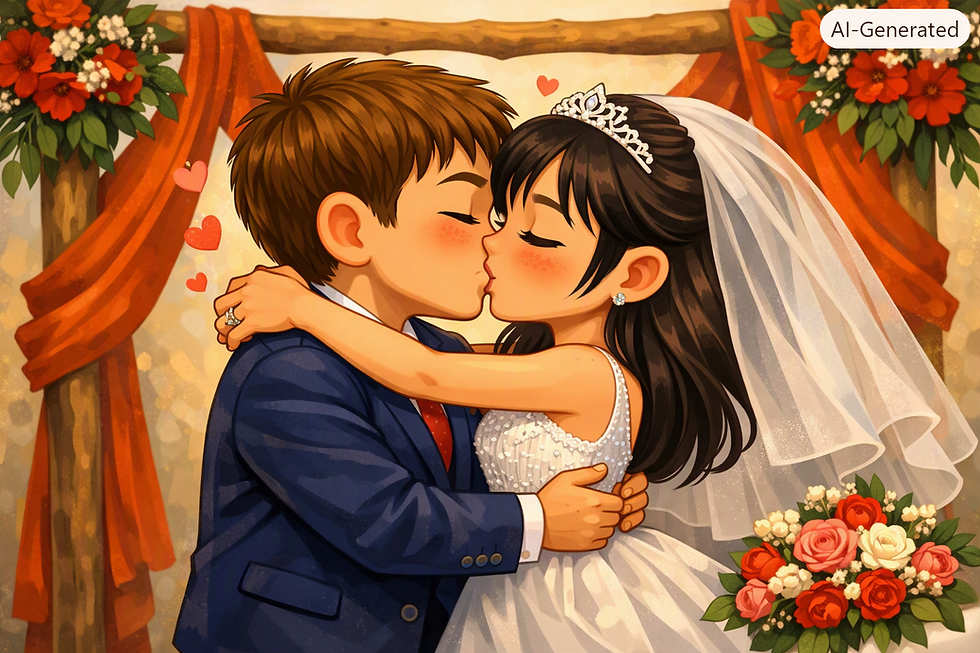
members gather supplies, neighbors lend tools, cousins make decorations, and beauty is created together rather than bought from a vendor. Sticks were gathered from the village. Fabric was selected with care. Flowers were trimmed, watered, and stored in Winnie's father's shed. Bouquets were assembled by cousins who laughed and chatted while they worked. Every piece carried fingerprints. Every detail carried effort. Every decoration carried love.
When Winnie walked down the aisle toward that handmade arch, accompanied by family and friends, we felt something no professional wedding venue could have provided.
We felt home.
Standing beside us was my friend Shane, who served as both officiant and bridge between our cultures. He delivered an American-style wedding sermon in Mandarin, sharing the meaning behind Christian marriage, commitment, and lifelong partnership in a way that Winnie's family could fully understand. For many of the villagers, Western wedding traditions were unfamiliar. Yet through Shane's words, every symbol, every vow, and every promise became accessible. In that moment, two cultures met not in opposition, but in harmony. Two families understood one another. Two traditions became one story.
Then, beneath that arch, Winnie and I exchanged vows.
The ceremony was simple. There were no grand productions, no expensive staging, and no elaborate spectacle. Yet the promises we made felt profound because they were shared in front of the people who had helped build every part of the day. The meaning came not from what surrounded us, but from what we said to one another.
Afterward, we cut our wedding cake.

The cake itself was simple and inexpensive, made by a small local bakery that had never created a wedding cake before. When I told the baker, "Make it beautiful," she interpreted the phrase literally and wrote those exact words on the cake. It became an unintended metaphor for our entire wedding. Beauty was not something we purchased. It was something we created.
Children lined the driveway waiting for a slice. People laughed, smiled, and gathered around something entirely new to many of them. The cake was not remarkable because of its design or cost. It was remarkable because of the joy it brought.
Meanwhile, more than three hundred guests filled the village. They did not arrive because they had received formal invitations. They came because, in her village, weddings are not exclusive events. They are community celebrations. Fires warmed the courtyards. Mahjong tiles clicked like music. Children ran between tables. A pig raised by her parents was prepared and shared as a symbol of abundance and blessing. A team of cooks worked from before sunrise until long after dark, serving meals with a rhythm that felt timeless. Nothing was polished. Nothing was curated. Yet everything felt alive.
And that was the lesson of our wedding.
Love does not require luxury. Commitment does not require spectacle. Joy does not require expense.
We did not cut corners. We cut noise.
We did not purchase meaning. We built it with family, culture, intention, and love.
Every tear, every laugh, every vow, and every shared meal felt just as powerful as anything that money could have bought. Perhaps even more powerful. Because it was ours. Because it honored both of our worlds. Because every decision was intentional.
Because it was Beautiful.
Wedding Video: Facebook
小红书 video part1
part 2
Wedding Cost Breakdown:
Ring — ¥17,873 → $2,639 USD
Proposal — ¥500 → $74 USD
Marriage book photo — ¥199 → $29 USD
Wedding photos — ¥1,699 → $251 USD
Wedding rings — ¥15,300 → $2,259 USD
Wedding suit — ¥2,580 → $381 USD
Travel — ¥270 → $40 USD
Party cigarettes — ¥2,000 → $295 USD
Pig — ¥5,000 → $738 USD
Food — ¥1,862 → $275 USD
Decorating — ¥350 → $52 USD
Dress — ¥280 → $41 USD
Cake — ¥200 → $30 USD
Chef team — ¥1,800 → $266 USD
Cǎilǐ (Still saved for us) — ¥88,000 → $13,006 USD
Including cǎilǐ
Total in RMB: ¥137,913
Total in USD: $20,687 USD
Excluding cǎilǐ
Total RMB: ¥49,913
Total USD: $7,375 USD
Here are some photos ☺️


Comments